Showing posts with label NGSS. Show all posts

Monday, May 13, 2019

Extensions of My Projects (TEA-ILEP Small Grant and Global Teacher Grant)

Paying Forward 


As an ILEP fellow, I was awarded with three grants. The first two were still under the TEA-ILEP Small Grant and both were for teacher-training initiatives. The first grant (2013 cycle) was my pilot attempt to spread awareness and advocacy for the NGSS (New Generation Science Standard) so I designed the project as a trainors' training for Math and Science teachers on how to integrate the Science and Engineering Practices in classroom instruction. For my second grant (2014 cycle), I facilitated a mentoring and coaching workshop for teachers and teacher-interns. For this project, I asked the two TGC fellows to share their expertise on Service Learning. Traditionally, service learning is considered as a pedagogical model but for my project, I tried to present it as an assessment tool. When the Philippines formally implemented the Senior High School, I applied for the third grant (2017 cycle) which was still on service learning. This third project was already under the Global Teachers Grant which I specifically designed to help senior high school students and teachers come up with service learning capstone projects. This time, service learning as both pedagogical model and as a summative assessment approach. Being a teacher leader is a great honor because more than the opportunities for professional advancement, it is a venue to extend help to others. Applying, winning, and implementing a grant project therefore, is my own way of paying forward. 
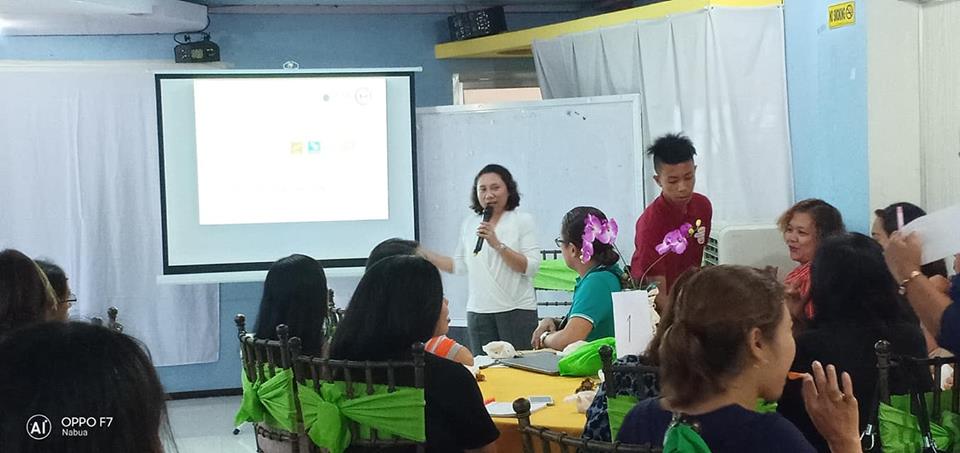
Together with another ILEP Fellow (M. Andrada, ILEP 2014 Fellow), I  shared about Science and Engineering Practices of the NGSS  (New Generation Science Standards) to high school science teachers last October 23, 2018. 

Brainstorming-in-action: Science teachers analyzing vignettes on Science and Engineering practices and thinking of ways how to integrated them in their own practice

Service Learning: Promising Initiatives 

Allow me to share three service learning projects that my senior high school students have completed. One project was made by a STEM group for their Science and Religion classes, while another was conducted by an ABM group for one of their elective classes. Another project that STEM students carried out was sponsoring a Physics class for a Grade 6 elementary class. 
A group of Grade 12 boys who were enrolled in STEM class made Physics fun for their   Grade 6 schoolmates.

"Mas malaki ka Juan, kaysa sa the Big One"

One of the student-facilitators explaining the "duck, cover, hold"

Grade 12-STEM students facilitated an earthquake emergency drill in one  adopted community
The real essence of a grant project is the impact that it leaves to the direct and indirect recipients and the sustainability of the target actions long after the project has been concluded. I always would like to think that my first project on service learning stirred the consciousness of teachers to align their course requirements to the call for social responsibility to the greater community. It is not just about making sure that students are able to achieve the learning competencies through their outputs but more importantly, the teacher becomes an instrument of change in the community. 

My second service learning project paved the way for reaching out for more beneficiaries and eventually a wider advocacy for giving back to the community through various forms of service. I am only sharing three student projects but there are 13 more that the pilot participants actually proposed. In the case of the ABM students who helped class treasurers in lower grade levels manage their class fund, the students themselves thought of calling themselves "mentors". This project is a concrete proof that students learn more when they teach another learner. 


Grade 12 - ABM students teaching class treasurers of elementary and junior high school classes how to record, budget, and monitor class fund
My only hope is that these grant projects would exemplify a ripple effect of the saying "be the change you want the world to be". 
NOTE: STEM and ABM are senior high school academic tracks in the Philippines. STEM is Science, Technology, Engineering and Mathematics while ABM is Accountancy, Business and Management. 
I am sincerely grateful to Ms. Marisol Andrada, Mr. Diego Contreras, Ms. Karen Belazon, Mr. James Esguerra and Ms. Alexandra Bacani for the photos included in this post. 


Tuesday, April 19, 2016

English Language Arts for Science Learners and Science for English Language Learners

Integrative Education starts with a paradigm shift


The RSA video can be accessed from https://www.youtube.com/watch?v=zDZFcDGpL4U


A Personal Reflection
Having gone through the three TESOL modules, (the fourth and last module is due this week) I realized that teaching science using English is an interdisciplinary task. NGSS and Science and Engineering practices are included in one of the modules and it is very clear that it is not as simple as including the practices in the plan or classifying learning tasks. They encompass both instruction and assessment. Another point for reflection is looking at the BICS and CALPS or the level of social and academic language proficiency of both teacher and learner. All the S&P practices entail a certain level of communication so it is very important that the teacher knows the level of proficiency of the students, in both receptive (listening and reading) and productive (speaking and writing) of the students. Every teacher must also exert effort in organizing the lesson in a way that it will address lexical (vocabulary), syntax (grammatical structure), and discourse (academic understanding) levels of language. The key to effectively using English as the language of science is first for the teacher to overcome difficulties as an English Language Learner (ELL), herself/himself. For instance, how can one define a quality blended learning objective if there is inferior language proficiency? 

Let me share some of the entries that I posted on the discussion fora. The first is a T-chart that compare and contrast two views about science education which was constructed after a study on the 21st century skills. This module made me reflect on my own application of the science and engineering practices. I think I need to analyze deeper how I really do instruction as far as making my students develop these practices according to their level of language proficiency. The second entry is a reflection about differentiated instruction based on varying levels of language proficiency. We must acknowledge that media poses a threat to the depreciating interest of students to academic English language. Teachers, must therefore exert more effort to become better models of academic discourses in English. The third is a synthesis of the challenges, the tools to use and proposed teacher training activities. The third is a table that highlights the alignment of S&P practices for recommended assessment techniques for EL in science. 

Friday, October 9, 2015

CONSTRUCTIVISM: Strengthening the bridge between the 21st century skills and the Science & Engineering practices

CONSTRUCTIVISM: Strengthening the bridge between the 21st century skills and the Science & Engineering practices 

 “Do not confine your children to your own learning for they were born in another time!”
The Hebrew proverb reminds us that our learners, or shall we say the millennials, have cognitive needs that are different from what their educators had when they were still learners themselves. Furthermore, the Flynn Effect provides the challenge for teachers to cope with the advancing level of intelligence of the new generation of learners. In the 21st century classroom, the teacher is no longer the lone authority on the subject matter but rather a co-learner and a facilitator of meaning making. Hence, there is no other more crucial educative moment for constructivism than the present time. 
Murphy (1997) defined constructivism as a paradigm where “knowledge is constructed by the individual through his interactions with his environment”. In this view, the learners do not passively receive information and practice rote learning but rather actively participate in the endeavor to “make sense of the world” through experiences that provide opportunities to develop meaning and understanding. In the most practical way of defining how a teacher would know if a learner understands, we can consider the six facets of understanding based on the Understanding by Design framework proposed by Wiggins and McTighe. A learner understands if he/she can explain, interpret, apply, perceive another perspective, do self-reflection, and express empathy. The BSCS (2004), through various NIH modules on science education, equates the constructivist approach into active learning which means that are involved “in doing things and thinking about the things they are doing”. The NIH modules are all designed for active, collaborative, and inquiry-based learning in biological science. In an active learning class, students are involved in more than listening. Teaching strategies place less emphasis on transmitting information and more on developing students’ skills. Students are involved in higher-order thinking such as analysis, synthesis, and evaluation. Instructors encourage students to explore their own understandings, attitudes, and values through more opportunities for engaged activities such as reading, discussing, and writing. In addition, academic learning time is spent more on integrated and collaborative tasks.    
The 5E Instructional Model is one example of an instructional design or framework that  exemplifies constructivism as an approach the acknowledges the role of the student as an active agent who “constructs” meaning out of his or her interactions with events (Perkins, 1992). According to this view, rather than passively absorbing information, the student redefines, reorganizes, elaborates, and changes his or her initial understandings through interactions with phenomena, the environment, and other individuals. In other words, the student interprets objects and phenomena and then internalizes this interpretation in terms of previous experiences (NIH-BSCS, 2004). A constructivist view of learning recognizes that the development of ideas and the acquisition of lasting understandings take time and experiences (Saunders, 1992). The key components of the 5E model, so-called because it takes students through five phases of learning that are easily described using five words that begin with the letter “E”: Engage, Explore, Explain, Elaborate, and Evaluate. The role of the teacher based on these 5Es are further explained in the table below. 
Source:  BSCS-NIH, 2004