Showing posts with label service learning. Show all posts

Friday, August 30, 2019

Service Learning Opportunities for Educators

As a global trend, service learning has been widely accepted as an effective pedagogy that replaces and/or complements the usual internship program in many colleges and universities across the world. The International Service Learning (ISL) website displays their organizational mantra "TRAVEL, SERVE, LEARN" in all caps perhaps to emphasize that service learning need not be a separate academic venue but should be accepted as a norm.

Know more about ISL, their programs and funding opportunities at https://islonline.org/
The UNESCO documents on global citizenship and various international collaborations are more than enough tools for any basic education school in the Philippines to infuse SL into the curriculum even if there is still no formal memo from DepEd. Nevertheless, we do not need a memo because as a 21st century core skill, civic engagement (a soft skill that comes in a plethora of terms) is a must for any educational institution who would prefer to evolve to become globally competitive rather than become a model of mediocrity and thereby losing its true purpose in the community.

Another international initiative is the Projects Abroad (PA). Both ISL and PA are for higher institutions, unfortunately both have not much volunteers from the Philippines, as compared to other countries. Both depend on voluntary participation but an innovative team can tap possible grant sources to be able to fund an independent project using ISL or PA as a venue.

Are you a junior or college student looking for an internship? Why not engage in a more meaningful service project? Know more about Projects Abroad in https://www.projects-abroad.org

In the Philippines, international schools would usually have the established SL programs for junior and senior high schools with national or international affiliations. Needless to say, they follow an international curriculum framework. Furthermore, the lack of a national institution to oversee SL and the demand for logistics and professional expertise on SL, contribute to the weak commitment of many Philippine basic education schools to really transform their community engagement programs into formal SL curriculum. Nevertheless, the current SHS program is an ideal opportunity to finally make SL a pedagogical practice in the Philippine educational landscape.

For a start, there are many SL conference opportunities that Filipino educators can explore. The Ohio State University (OSU) website has a list of various conferences across the US. See the list thru this link: Service-Learning Conference Opportunities. The University of Nebraska Omaha website also features a list of US and international SL conferences. See the list thru this link: UNOMAHA list of SL conferences. Traveling and experiencing a different ambiance is always a life-changing event, so why not bring your SHS students to a conference, either as a spectator, workshop participant or even a presenter. Sometimes, the ingenuity of a teacher is a much needed push to provide a once-in-a-lifetime opportunity for a young learner. A small campus-based project can be transformed and presented as a full SL paper in a conference. The 2020 SL conference of the National Youth Leadership Conference (NYCL) is an ideal venue for both students and teachers who would like to benchmark and test the waters for SL in a high school setting. 

Explore something different and have the opportunity to make a difference! Join the 2020 National Service Learning Conference. Know more about it thru their official conference page: https://www.nylc.org/page/conference


Not knowing about something is not an excuse but learning more means knowing less. In other words, a true teacher fuels his/her passion and commitment to teaching. There are various opportunities to understand and help one understand how to jumpstart SL. The National Geographic, for example has a free online course "Integrating Service with Goals. As of this writing, registration is still open.
Sign up at https://www.nationalgeographic.org/education/professional-development/courses/

I also found one on Coursera, "Compassionate Leadership Through Service Learning with Jane Goodall and Roots & Shoots". This is offered by the University of Colorado- Boulder. Another one, "Networking and Volunteerism for Career Success" is being offered by the University of California San Diego. Both courses start August 31. A lot more reading materials and videos are accessible for free in the internet. Numerous novels, TV series, documentaries, and movies have also featured service learning projects either in the formal school or educational extension context.

Furthermore, there are publishing opportunities for researchers and educators who would like to consider SL as an area of expertise. Purdue University Libraries and School Information Studies has come up with a partial list of major publications. See the list, explore and read thru this link:  SL Publishing Opportunities

This is the 21st century and everything you want to learn is on the web. 
Be smart teachers! Do I need to say more? 

Monday, May 13, 2019

Extensions of My Projects (TEA-ILEP Small Grant and Global Teacher Grant)

Paying Forward 


As an ILEP fellow, I was awarded with three grants. The first two were still under the TEA-ILEP Small Grant and both were for teacher-training initiatives. The first grant (2013 cycle) was my pilot attempt to spread awareness and advocacy for the NGSS (New Generation Science Standard) so I designed the project as a trainors' training for Math and Science teachers on how to integrate the Science and Engineering Practices in classroom instruction. For my second grant (2014 cycle), I facilitated a mentoring and coaching workshop for teachers and teacher-interns. For this project, I asked the two TGC fellows to share their expertise on Service Learning. Traditionally, service learning is considered as a pedagogical model but for my project, I tried to present it as an assessment tool. When the Philippines formally implemented the Senior High School, I applied for the third grant (2017 cycle) which was still on service learning. This third project was already under the Global Teachers Grant which I specifically designed to help senior high school students and teachers come up with service learning capstone projects. This time, service learning as both pedagogical model and as a summative assessment approach. Being a teacher leader is a great honor because more than the opportunities for professional advancement, it is a venue to extend help to others. Applying, winning, and implementing a grant project therefore, is my own way of paying forward. 
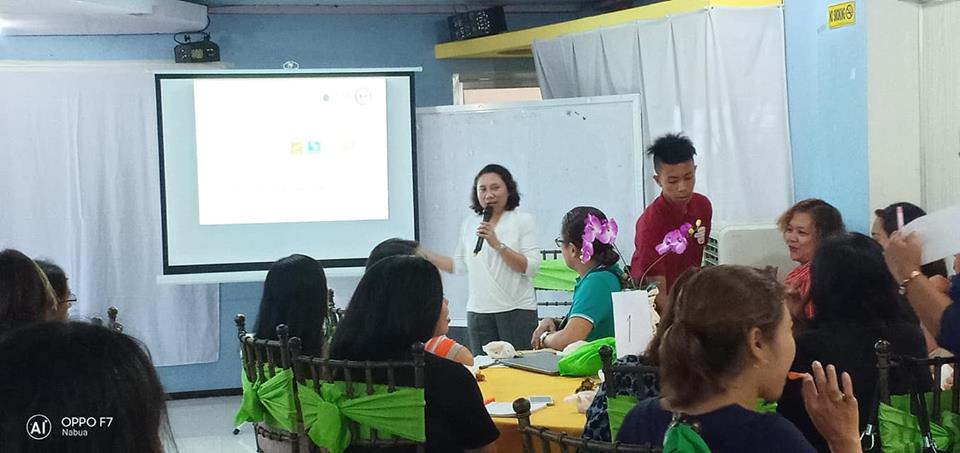
Together with another ILEP Fellow (M. Andrada, ILEP 2014 Fellow), I  shared about Science and Engineering Practices of the NGSS  (New Generation Science Standards) to high school science teachers last October 23, 2018. 

Brainstorming-in-action: Science teachers analyzing vignettes on Science and Engineering practices and thinking of ways how to integrated them in their own practice

Service Learning: Promising Initiatives 

Allow me to share three service learning projects that my senior high school students have completed. One project was made by a STEM group for their Science and Religion classes, while another was conducted by an ABM group for one of their elective classes. Another project that STEM students carried out was sponsoring a Physics class for a Grade 6 elementary class. 
A group of Grade 12 boys who were enrolled in STEM class made Physics fun for their   Grade 6 schoolmates.

"Mas malaki ka Juan, kaysa sa the Big One"

One of the student-facilitators explaining the "duck, cover, hold"

Grade 12-STEM students facilitated an earthquake emergency drill in one  adopted community
The real essence of a grant project is the impact that it leaves to the direct and indirect recipients and the sustainability of the target actions long after the project has been concluded. I always would like to think that my first project on service learning stirred the consciousness of teachers to align their course requirements to the call for social responsibility to the greater community. It is not just about making sure that students are able to achieve the learning competencies through their outputs but more importantly, the teacher becomes an instrument of change in the community. 

My second service learning project paved the way for reaching out for more beneficiaries and eventually a wider advocacy for giving back to the community through various forms of service. I am only sharing three student projects but there are 13 more that the pilot participants actually proposed. In the case of the ABM students who helped class treasurers in lower grade levels manage their class fund, the students themselves thought of calling themselves "mentors". This project is a concrete proof that students learn more when they teach another learner. 


Grade 12 - ABM students teaching class treasurers of elementary and junior high school classes how to record, budget, and monitor class fund
My only hope is that these grant projects would exemplify a ripple effect of the saying "be the change you want the world to be". 
NOTE: STEM and ABM are senior high school academic tracks in the Philippines. STEM is Science, Technology, Engineering and Mathematics while ABM is Accountancy, Business and Management. 
I am sincerely grateful to Ms. Marisol Andrada, Mr. Diego Contreras, Ms. Karen Belazon, Mr. James Esguerra and Ms. Alexandra Bacani for the photos included in this post. 


Monday, June 22, 2015

Service Learning is community engagement much more than volunteerism or outreach activity

www.pnc.edu
What service learning is and how it differs from community outreach
Service Learning allows students to learn by doing, connecting theory with practice and a method of learning through active participation in organized experiences that meet community needs (Perkins, 1994). Bringle and Hatcher (1996) defined SL as “credit bearing educational experience”. SL evolved, in part, from core assumptions John Dewey (1916, 1939), who advocate learning by doing. SL offered a powerful pedagogical alternative (Billig, 2000) that allowed in which students gain further understanding of the course content, a broader appreciation of the discipline and an enhanced sense of civic responsibility (Bringle and Hatcher, 1996). The National Society for Experiential Education provides the most comprehensive definition of SL as pedagogy, which regard SL as “any carefully monitored service experience in which a student has intentional learning goals and reflects actively on what he or she is learning throughout the experience.” The definition given by the Corporation for National Service is much narrower – “ a method under which students or participants learn and develop through active participation in thoughtfully organized service (Billig, 2000).  The use of SL within the context of developing college students’ moral development and social and academic involvement is supported by numerous higher education theories, including Astin’s Theory of Student Development [1984], Tinto’s Model of Student Integration [1975; 1993], and Kohlberg’s Theory of Moral Development [1984] (Taggart and Crisp, 2011).

Service Learning is a concept that incorporates two main aspects – helping a community and participation in a learning situation (Guisse, Tshuma, Victor, Papasin, Lopes, and Bakri , 2010). SL is a set of experiences (Univeristy of Toronto, 2014) that provides students with opportunities to “exercise knowledge and concepts gained in academic classroom in the more meaningful, relevant context in their communities”. It is also a pedagogical model that links academic content with direct practice through critical reflection (UT, 2014; Begley 1013) and aims to “enhance student classroom experiences and community engagement through targeted service that meets community-identified needs and reflection activities that integrate that service back into the academic framework of the course“ (Begley, 2013); as well as, teach civic responsibility, and strengthen communities (National Service Learning Clearing-house, 2009). We can therefore consider SL as a reciprocal approach to teaching and learning because while the students apply what they learn in real-life situations, they are able to help a community or an institution. In return, not only does the service recipient gain help but also provides additional learning to the students. 

It is very clear that SL is much more comprehensive than community outreach or the usual volunteer work. SL has two basic attributes that are not really a requirement for volunteer work – academic integration and reflection.  The University of Toronto (2014) clarifies that unlike extracurricular voluntary service, SL is primarily centered on academic knowledge development and thus guided by discipline-specific learning goals. Experiential learning students facilitate achievement of academic goals more effectively while critical reflection enables the students to identify how their academic content knowledge has enhanced the value of their service and how their understanding of the discipline has been strengthened by their practice. Volunteer work or community outreach endeavor, most of the time, focuses only on the act of serving or helping another without considering the benefits that the volunteer actually gain from such experience. The Afterschool Alliance (2011) summarizes the differences between SL and community service as presented in Table 1. 


Regardless whether SL is viewed as a required course in higher education, as a capstone project or a mere curricular activity, community engagement through voluntary service anchored on curricular goals, SL can be considered as an urgent call for all educators. The rationale behind this argument is very well defined by the Afterschool Alliance (2011), “Youth are the future torchbearers for these causes, and so engaging children of all ages in volunteering, and more importantly, allowing them to create their own service projects, is vital to the betterment of their communities, country and the world at large (Afterschool alliance, 2011). Without a doubt, both types of service are extremely valuable in all social contexts. Service learning therefore is an opportunity for students to learn and grow from their experiences and at the same time create positive change in the community. Unfortunately, in the Philippine setting, SL is not as established as it is in other countries because volunteer work in our country follows more the CO rather than the SL model. Even the majority of NSTP course in undergraduate and the community affairs department of many religious schools are also in accordance with CO approach. Hence, the need for this paper. 

Very clearly, the Corporation for National Service enumerated the basic qualities of a SL initiative (Billig, 2000): (1) conducted in and meets the needs of a community; (2) coordinated with an elementary school, secondary school, institution of higher education, or community-service program and with the community;  (3) helps foster civic responsibility; (4) integrated into and enhances the (core) academic curriculum of the students, or the educational components of the community-service program in which the participants are enrolled; and (5) provides structured time for the students or participants to reflect on the service experience.  Various authors, researchers and educational institutions or groups would have their own definition and attributes of SL but there are basic concepts that all of them agree, according to Billig (2000). SL involves "active participation, thoughtfully organized experiences, focus on community needs and school/community coordination, academic curriculum integration, structured time for reflection, opportunities for application of skills and knowledge, extended learning opportunities, and development of a sense of caring for others. Furthermore, disagreements on the definition of SL only arise when distinguishing it from other experiential education approaches, such as volunteer and community service, internships, field studies, and cross-age peer tutoring. 

Service Learning: A brief introduction

http://carrollucommsoc.weebly.com/news--events.html
Ang kabataan ang pag-asa ng bayan.”  - Dr. Jose Rizal.

"Tell me and I forget, teach me and I remember, involve me and I learn" - Benjamin  Franklin

The two classical clichés above are the main inspiration for instigating service learning initiatives in my own little way. Globalization highlights global citizenship, which further challenges the education sector to strike the balance between character building for nation building and moral formation for social accountability. The nationwide implementation of the senior high school across the country further, on the other hand, poses the challenge to the basic education sector to develop among the learners the 21st century skills to prepare them for a working environment and opportunities whose rules and expectations have not been defined yet. Within this perspective, we can consider that as society evolves so are the nature of the learners and therefore educators must adapt strategies that address their emerging needs, including being a more active participant in the global community. In today’s era when teaching and learning are designed based on standards rather than short-term objectives, it is imperative to also innovate practices to encourage commitment to social concerns – a difficult task in a society characterized by consumerism and competition. 

           Service learning provides the bridge between academic development and civic responsibilities. As what former US senator and astronaut John Glenn has said, “By its very definition, civic responsibility means taking a healthy role in the life of one’s community, state and nation. That means that classroom lessons should be complemented by work outside the classroom. Service learning does just that, tying community service to academic lessons.” Therefore the challenge how to address the ethical, social values and virtues, as Kenan (2009) has pointed out, not only for educators but for everyone who is interested in the education of next generations.  

In the traditional value infusion in the life sciences, environmental advocacy and health concerns are the predominant themes. However, biology is now considered an interdisciplinary area whose practical applications encompass almost all of human endeavors. My goal is not really to talk about SL as if I really understand it but to sell the idea that we can make a difference and something good out of SL. I do hopes to promote the centrality of biology’s role in today’s world through service learning. At the same time, through service learning, engaging in biological studies could provide a wider perspective that biology, as a career and field of expertise, is not limited to the medicine or health allied courses and research work. The objectives of my succeeding posts would be (1) to clarify the definition of service learning (SL), how it differs from community outreach, (2) to elucidate the benefits of applying SL as a teaching approach, as an interdisciplinary course or as a capstone project, (3) to suggest ways how to incorporate SL in biology subjects in high school, and (4) to justify how SL enable the teaching of biology to address the NGSS science and engineering practices and the 21st century skills. 

SERVICE LEARNING IN BIOLOGY in a nutshell

SERVICE LEARNING AS A 21ST CENTURY SKILL

 
www.wcboe.org
Last year, I attempted to explore on service learning as applied in biological sciences. It was a serendipitous initiative because as I browse for references on SL, I discovered many documents that are research-based. With the on-going work on NGSS, particularly the science and engineering practices, SL is really having the spotlight as a promising area for developing and deepening 21st century skills. In the case of science, Biology in particular, the challenge is how to merge advocacies with the basic attributes of SL and striking a balance with an authentic integration of the 21st century skills. Several times in the past, (I know many would agree) that classroom and co-curricular activities were a "potpourri" of activities. Teachers and learners enjoy very much the experience per se but somewhere in the instruction, authenticity and sustainability are neglected. When we focus on the short-term effects, we defeat the long-term vision of the curriculum. Here is the abstract of the paper which  hope to post on the blog in the hope of gathering more advocates for Service Learning and 21st century skills in teaching Biology.


Many thanks to Dr. Bagarinao of UPOU who encouraged me to pursue the topic on SL, and for his constructive feedbacks, as well.