Friday, August 30, 2019

Service Learning Opportunities for Educators

As a global trend, service learning has been widely accepted as an effective pedagogy that replaces and/or complements the usual internship program in many colleges and universities across the world. The International Service Learning (ISL) website displays their organizational mantra "TRAVEL, SERVE, LEARN" in all caps perhaps to emphasize that service learning need not be a separate academic venue but should be accepted as a norm.

Know more about ISL, their programs and funding opportunities at https://islonline.org/
The UNESCO documents on global citizenship and various international collaborations are more than enough tools for any basic education school in the Philippines to infuse SL into the curriculum even if there is still no formal memo from DepEd. Nevertheless, we do not need a memo because as a 21st century core skill, civic engagement (a soft skill that comes in a plethora of terms) is a must for any educational institution who would prefer to evolve to become globally competitive rather than become a model of mediocrity and thereby losing its true purpose in the community.

Another international initiative is the Projects Abroad (PA). Both ISL and PA are for higher institutions, unfortunately both have not much volunteers from the Philippines, as compared to other countries. Both depend on voluntary participation but an innovative team can tap possible grant sources to be able to fund an independent project using ISL or PA as a venue.

Are you a junior or college student looking for an internship? Why not engage in a more meaningful service project? Know more about Projects Abroad in https://www.projects-abroad.org

In the Philippines, international schools would usually have the established SL programs for junior and senior high schools with national or international affiliations. Needless to say, they follow an international curriculum framework. Furthermore, the lack of a national institution to oversee SL and the demand for logistics and professional expertise on SL, contribute to the weak commitment of many Philippine basic education schools to really transform their community engagement programs into formal SL curriculum. Nevertheless, the current SHS program is an ideal opportunity to finally make SL a pedagogical practice in the Philippine educational landscape.

For a start, there are many SL conference opportunities that Filipino educators can explore. The Ohio State University (OSU) website has a list of various conferences across the US. See the list thru this link: Service-Learning Conference Opportunities. The University of Nebraska Omaha website also features a list of US and international SL conferences. See the list thru this link: UNOMAHA list of SL conferences. Traveling and experiencing a different ambiance is always a life-changing event, so why not bring your SHS students to a conference, either as a spectator, workshop participant or even a presenter. Sometimes, the ingenuity of a teacher is a much needed push to provide a once-in-a-lifetime opportunity for a young learner. A small campus-based project can be transformed and presented as a full SL paper in a conference. The 2020 SL conference of the National Youth Leadership Conference (NYCL) is an ideal venue for both students and teachers who would like to benchmark and test the waters for SL in a high school setting. 

Explore something different and have the opportunity to make a difference! Join the 2020 National Service Learning Conference. Know more about it thru their official conference page: https://www.nylc.org/page/conference


Not knowing about something is not an excuse but learning more means knowing less. In other words, a true teacher fuels his/her passion and commitment to teaching. There are various opportunities to understand and help one understand how to jumpstart SL. The National Geographic, for example has a free online course "Integrating Service with Goals. As of this writing, registration is still open.
Sign up at https://www.nationalgeographic.org/education/professional-development/courses/

I also found one on Coursera, "Compassionate Leadership Through Service Learning with Jane Goodall and Roots & Shoots". This is offered by the University of Colorado- Boulder. Another one, "Networking and Volunteerism for Career Success" is being offered by the University of California San Diego. Both courses start August 31. A lot more reading materials and videos are accessible for free in the internet. Numerous novels, TV series, documentaries, and movies have also featured service learning projects either in the formal school or educational extension context.

Furthermore, there are publishing opportunities for researchers and educators who would like to consider SL as an area of expertise. Purdue University Libraries and School Information Studies has come up with a partial list of major publications. See the list, explore and read thru this link:  SL Publishing Opportunities

This is the 21st century and everything you want to learn is on the web. 
Be smart teachers! Do I need to say more? 

Monday, May 13, 2019

Extensions of My Projects (TEA-ILEP Small Grant and Global Teacher Grant)

Paying Forward 


As an ILEP fellow, I was awarded with three grants. The first two were still under the TEA-ILEP Small Grant and both were for teacher-training initiatives. The first grant (2013 cycle) was my pilot attempt to spread awareness and advocacy for the NGSS (New Generation Science Standard) so I designed the project as a trainors' training for Math and Science teachers on how to integrate the Science and Engineering Practices in classroom instruction. For my second grant (2014 cycle), I facilitated a mentoring and coaching workshop for teachers and teacher-interns. For this project, I asked the two TGC fellows to share their expertise on Service Learning. Traditionally, service learning is considered as a pedagogical model but for my project, I tried to present it as an assessment tool. When the Philippines formally implemented the Senior High School, I applied for the third grant (2017 cycle) which was still on service learning. This third project was already under the Global Teachers Grant which I specifically designed to help senior high school students and teachers come up with service learning capstone projects. This time, service learning as both pedagogical model and as a summative assessment approach. Being a teacher leader is a great honor because more than the opportunities for professional advancement, it is a venue to extend help to others. Applying, winning, and implementing a grant project therefore, is my own way of paying forward. 
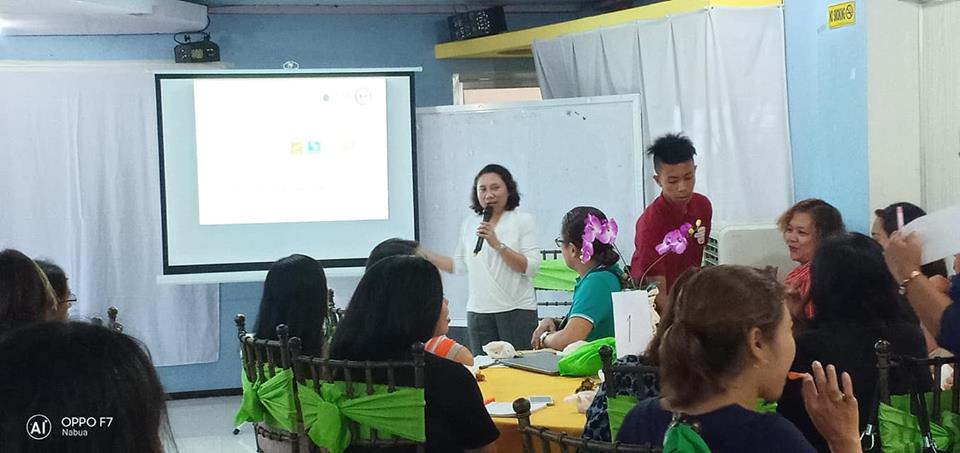
Together with another ILEP Fellow (M. Andrada, ILEP 2014 Fellow), I  shared about Science and Engineering Practices of the NGSS  (New Generation Science Standards) to high school science teachers last October 23, 2018. 

Brainstorming-in-action: Science teachers analyzing vignettes on Science and Engineering practices and thinking of ways how to integrated them in their own practice

Service Learning: Promising Initiatives 

Allow me to share three service learning projects that my senior high school students have completed. One project was made by a STEM group for their Science and Religion classes, while another was conducted by an ABM group for one of their elective classes. Another project that STEM students carried out was sponsoring a Physics class for a Grade 6 elementary class. 
A group of Grade 12 boys who were enrolled in STEM class made Physics fun for their   Grade 6 schoolmates.

"Mas malaki ka Juan, kaysa sa the Big One"

One of the student-facilitators explaining the "duck, cover, hold"

Grade 12-STEM students facilitated an earthquake emergency drill in one  adopted community
The real essence of a grant project is the impact that it leaves to the direct and indirect recipients and the sustainability of the target actions long after the project has been concluded. I always would like to think that my first project on service learning stirred the consciousness of teachers to align their course requirements to the call for social responsibility to the greater community. It is not just about making sure that students are able to achieve the learning competencies through their outputs but more importantly, the teacher becomes an instrument of change in the community. 

My second service learning project paved the way for reaching out for more beneficiaries and eventually a wider advocacy for giving back to the community through various forms of service. I am only sharing three student projects but there are 13 more that the pilot participants actually proposed. In the case of the ABM students who helped class treasurers in lower grade levels manage their class fund, the students themselves thought of calling themselves "mentors". This project is a concrete proof that students learn more when they teach another learner. 


Grade 12 - ABM students teaching class treasurers of elementary and junior high school classes how to record, budget, and monitor class fund
My only hope is that these grant projects would exemplify a ripple effect of the saying "be the change you want the world to be". 
NOTE: STEM and ABM are senior high school academic tracks in the Philippines. STEM is Science, Technology, Engineering and Mathematics while ABM is Accountancy, Business and Management. 
I am sincerely grateful to Ms. Marisol Andrada, Mr. Diego Contreras, Ms. Karen Belazon, Mr. James Esguerra and Ms. Alexandra Bacani for the photos included in this post. 


Sunday, February 12, 2017

Happy 208th birthday Darwin!

Darwin Day 2017


Born Charles Robert Darwin on Feb. 12, 1809, he just turned 208th if he were still alive.
Charles Darwin was one of the most influential naturalists whose work is still considered one of the best, truly a classic, of all time.


The whole month of February is celebrated as Darwin month, proof of how important he is. Every biology student, teacher, researcher, and educator should find inspiration from his works. Not only are his papers proof of his ingenuity but more importantly of the scientific attitude and passion that he greatly exemplified.


Celebrations around the world listed in this link: https://ncse.com/ncse-events


BSCS has a comprehensive collection of teacher and student materials on Darwin's life, work and on studying evolution which can be accessed from this link: https://bscs.org/celebrating-darwin-day-feb-12-2017


Get to know more about him through the Wikipedia entry on his life and work:
https://en.wikipedia.org/wiki/Charles_Darwin  and  read his papers from: http://darwin-online.org.uk/


His Theory on the Origin of Species is captured in a short film from the Howard Hughes Medical Institute website: http://www.hhmi.org/biointeractive/origin-species-making-theory?utm_source=BioInteractive+News&utm_campaign=251450aa2e-BioInteractive_News_Vol_212_11_2014&utm_medium=email&utm_term=0_98b2f5c6ba-251450aa2e-69202269


Wednesday, October 19, 2016

Remembering Tatay on his 70th

Tatay would have been 70 years old today.

Tatay, when he was about my age. 
What I always remember about my father: 
He held my hand to cut my first birthday cake. When I was in primary, he would protect my notebooks with plastic cover. When I was in the intermediate grades up to high school he would draw me laboratory tools and write down their uses. He was not a chemist but working as a laboratory technician, he knows the chemical formula, names, mixing protocols, handling, etc. 
My 1st birthday family pic
When I took the UPCAT he was outside the CEAT-UP lecture hall, peeking through the window and watching me take the exam from 8am to 12nn. He was with me when I needed to go, for the first time to UP Diliman library and waited for the entire day outside. When I was in college, the only time I got sick, I remember him waking me up in the middle of the night so I can take the medicine and be able to come to school again the next morning. 

On my first job, he went with me for my final interview in Manila. When I worked in the research laboratory, he would fetch me late at night after setting up an experiment that would last the whole evening. 

But what I would always remember is whenever our viand has no soup or sauce, there would always be a bottle of Coke to pair with whatever fried meat or fish. For 36 years, he took care of me and I was only given 36 days to return that favor. 

I was there when he got a heart attack on the eve of his 65th birthday and when he was revived at dawn. I was there when he took his last meal, I administered his last insulin shot and made the last adjustment to his oxygen, hoping against hope that he would last another birthday. I think I was the only one to whom he would reminisce his memories as a child with his own father, during his last week. And I was there when finally he took his last breath. 
I feel sad for those who never knew their father, and I pity those who cannot remember even a single good memory with their father. For the things my Tatay did as I was growing up and what he made me witness on his last days, he wanted me to remember: "I am smart and I am strong"; a first born favorite, all along [just like him].

Tuesday, April 19, 2016

English Language Arts for Science Learners and Science for English Language Learners

Integrative Education starts with a paradigm shift


The RSA video can be accessed from https://www.youtube.com/watch?v=zDZFcDGpL4U


A Personal Reflection
Having gone through the three TESOL modules, (the fourth and last module is due this week) I realized that teaching science using English is an interdisciplinary task. NGSS and Science and Engineering practices are included in one of the modules and it is very clear that it is not as simple as including the practices in the plan or classifying learning tasks. They encompass both instruction and assessment. Another point for reflection is looking at the BICS and CALPS or the level of social and academic language proficiency of both teacher and learner. All the S&P practices entail a certain level of communication so it is very important that the teacher knows the level of proficiency of the students, in both receptive (listening and reading) and productive (speaking and writing) of the students. Every teacher must also exert effort in organizing the lesson in a way that it will address lexical (vocabulary), syntax (grammatical structure), and discourse (academic understanding) levels of language. The key to effectively using English as the language of science is first for the teacher to overcome difficulties as an English Language Learner (ELL), herself/himself. For instance, how can one define a quality blended learning objective if there is inferior language proficiency? 

Let me share some of the entries that I posted on the discussion fora. The first is a T-chart that compare and contrast two views about science education which was constructed after a study on the 21st century skills. This module made me reflect on my own application of the science and engineering practices. I think I need to analyze deeper how I really do instruction as far as making my students develop these practices according to their level of language proficiency. The second entry is a reflection about differentiated instruction based on varying levels of language proficiency. We must acknowledge that media poses a threat to the depreciating interest of students to academic English language. Teachers, must therefore exert more effort to become better models of academic discourses in English. The third is a synthesis of the challenges, the tools to use and proposed teacher training activities. The third is a table that highlights the alignment of S&P practices for recommended assessment techniques for EL in science.